
L-Theanine
L-Theanine (CAS 3081-61-6) is an amino acid found naturally in tea leaves, supplied as a white crystalline powder for dietary supplements and functional beverages.
Identity
What it is.
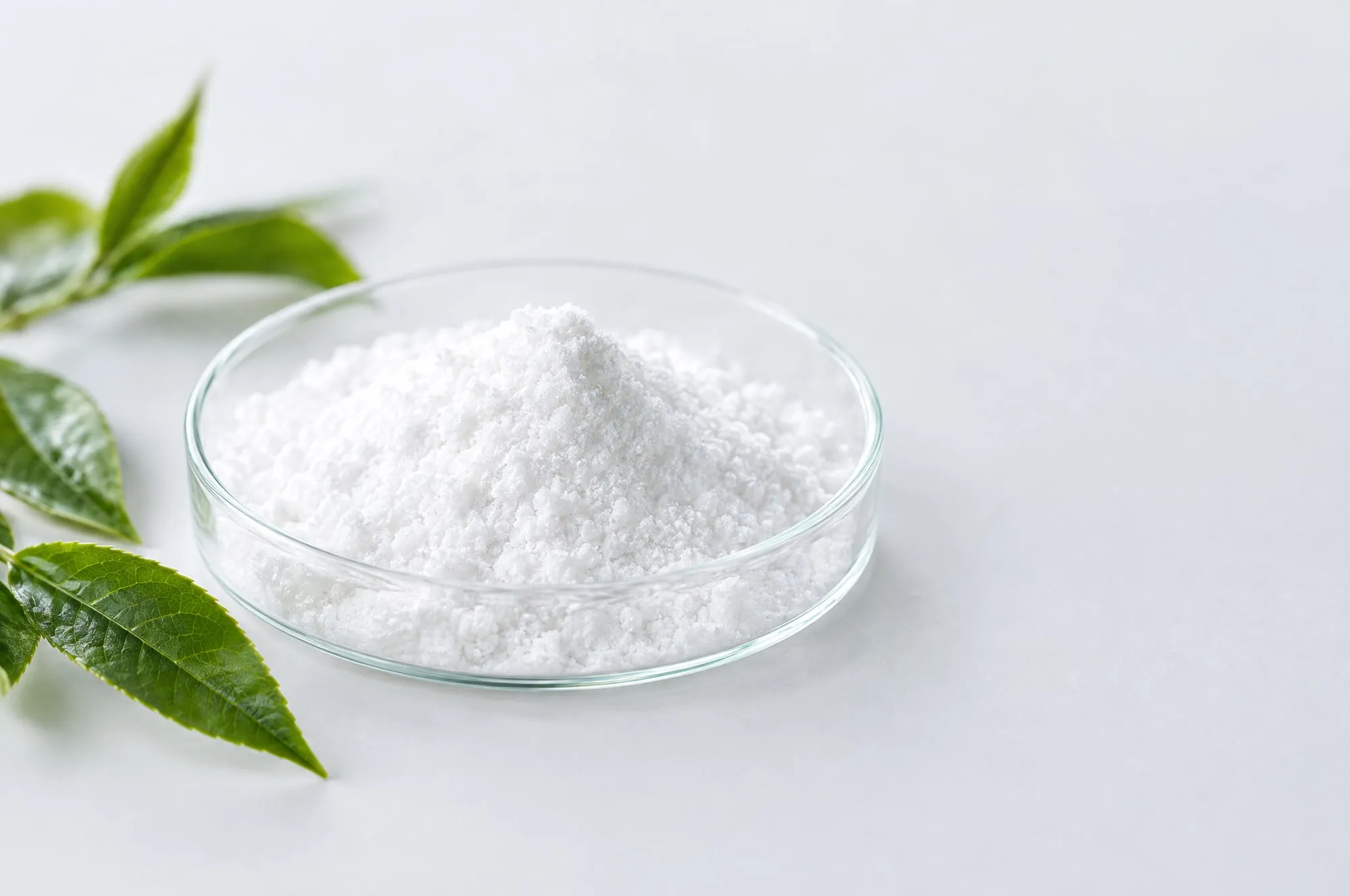
L-Theanine is the amino acid that gives green tea much of its savoury character. As an ingredient it is a white, water-soluble, nearly tasteless powder, which makes it easy to use in capsules, gummies, drink mixes and ready-to-drink beverages.
We manufacture L-theanine by fermentation at 98.5% purity and above and supply it direct, which keeps pricing competitive and lead times short for brands and contract manufacturers scaling relaxation, sleep, focus and energy products.
Also known as: N-Ethyl-L-glutamine, γ-Glutamylethylamide, L-γ-Glutamylethylamide, N⁵-Ethyl-L-glutamine.
- CAS number
- 3081-61-6
- Molecular formula
- C₇H₁₄N₂O₃
- Molecular weight
- 174.20 g/mol
- Appearance
- White crystalline powder
- Solubility
- Freely soluble in water
- HTS heading
- 2924.19
- Country of origin
- China
Specifications
Specifications.
Every batch is tested against the specification below and shipped with a certificate of analysis reporting the result and method for each test.
L-Theanine 98.5%
White crystalline powder for supplements, beverages and cosmetics.
| Test | Specification | Batch result | Method |
|---|---|---|---|
| Description | White or off-white crystalline powder | Conforms | Visual |
| Assay | 98.5% – 101.0% | 98.7% | QB/T 5633.11 |
| Specific rotation | +7.7° to +8.5° | +8.0° | GB/T 613 |
| pH | 5.0 – 6.0 | 5.8 | GB/T 9724 |
| Solution clarity | Clear and colourless | Conforms | — |
| Loss on drying | NMT 0.2% | 0.06% | — |
| Residue on ignition | NMT 0.1% | 0.04% | GB 5009.4 |
| Other amino acids | NMT 0.5% | Conforms | QB/T 5633.11 |
| Chloride | NMT 0.02% | < 0.02% | — |
| Sulfate | NMT 0.02% | < 0.02% | — |
| Iron | NMT 10 ppm | < 10 ppm | — |
| Lead | NMT 0.5 ppm | < 0.5 ppm | GB 5009.12 |
| Arsenic | NMT 0.5 ppm | < 0.5 ppm | GB 5009.11 |
| Cadmium | NMT 1 ppm | < 1 ppm | GB 5009.268 |
| Mercury | NMT 0.1 ppm | < 0.1 ppm | GB 5009.268 |
| Aerobic plate count | NMT 1,000 CFU/g | < 1,000 CFU/g | GB 4789.2 |
| Yeast and mould | NMT 50 CFU/g | < 50 CFU/g | GB 4789.15 |
| Coliforms | Negative | Not detected | GB 4789.3 |
| Salmonella | Negative | Not detected | GB 4789.4 |
| Staphylococcus aureus | Negative | Not detected | GB 4789.10 |
Packaging and storage
- Packaging
- 25 kg drums
- Shelf life
- 2 years from manufacture
- Storage
- Cool, dry place in the closed original container
- Production
- Fermentation, at our plant in Xintai, Shandong
Applications
Where it is used.
Dietary supplements
Capsules, tablets, gummies, softgels and powders, alone or combined with caffeine, magnesium or botanicals.
Industry pageFunctional beverages
Energy drinks, ready-to-drink teas, shots and drink mixes. Dissolves clear and adds little taste.
Industry pageCosmetics and personal care
Skin-care and personal-care formulations. Ask us for the cosmetic-grade specification.
Industry pageRegulatory
Regulatory status.
A summary for formulators and quality teams.
Food and beverage use
L-Theanine is used in U.S. foods and beverages on the basis of GRAS notices to which FDA has responded with "no questions" letters. We provide the regulatory documentation for our material with every quotation.
Dietary supplement use
L-Theanine is widely used in U.S. dietary supplements. Each batch is supplied with a certificate of analysis to support identity testing under 21 CFR 111.75.
Documentation
Documentation, as standard.
Every shipment carries a certificate of analysis that names our manufacturing site, Xintai Jiahe Biotech Co., Ltd.. The full document pack is sent with your quotation, so your QA review can start straight away.
Also tested by Centre Testing International (CTI), an independent laboratory. The report is available on request.
- Certificate of analysis for the batch
- Specification sheet
- Safety data sheet (SDS)
- Test methods
- FSSC 22000, ISO 9001, HACCP and Halal certificates
- Allergen statement
- GMO statement
- Residual solvent statement
- Heavy-metal results
- Country-of-origin statement
- Supply-chain traceability statement
Questions
L-Theanine: common questions.
What is L-theanine?
L-Theanine is a non-protein amino acid, N-ethyl-L-glutamine, that occurs naturally in tea (Camellia sinensis). Its CAS number is 3081-61-6. Commercial L-theanine is a white crystalline powder that dissolves freely in water.
How is commercial L-theanine made?
There are three main routes: enzymatic conversion from L-glutamine and ethylamine, chemical synthesis, and microbial fermentation. All three can produce L-theanine above 98% purity. The route matters for regulatory purposes because GRAS notices are specific to a process.
Is L-theanine GRAS?
FDA has responded with "no questions" letters to several GRAS notices for L-theanine, covering use in beverages and other foods. Each notice describes a production process and intended uses, so ask your supplier for the regulatory documentation for the material you are buying. We include ours with every quotation.
What is the difference between L-theanine and theanine?
Theanine exists as two mirror-image forms, L and D. The L-form is the one found in tea and used in supplements. A specific rotation test on the certificate of analysis confirms the material is the L-isomer.
Quote L-Theanine.
Get pricing and full documentation in one inquiry. Our team responds within one business day.