
Riboflavin (Vitamin B2)
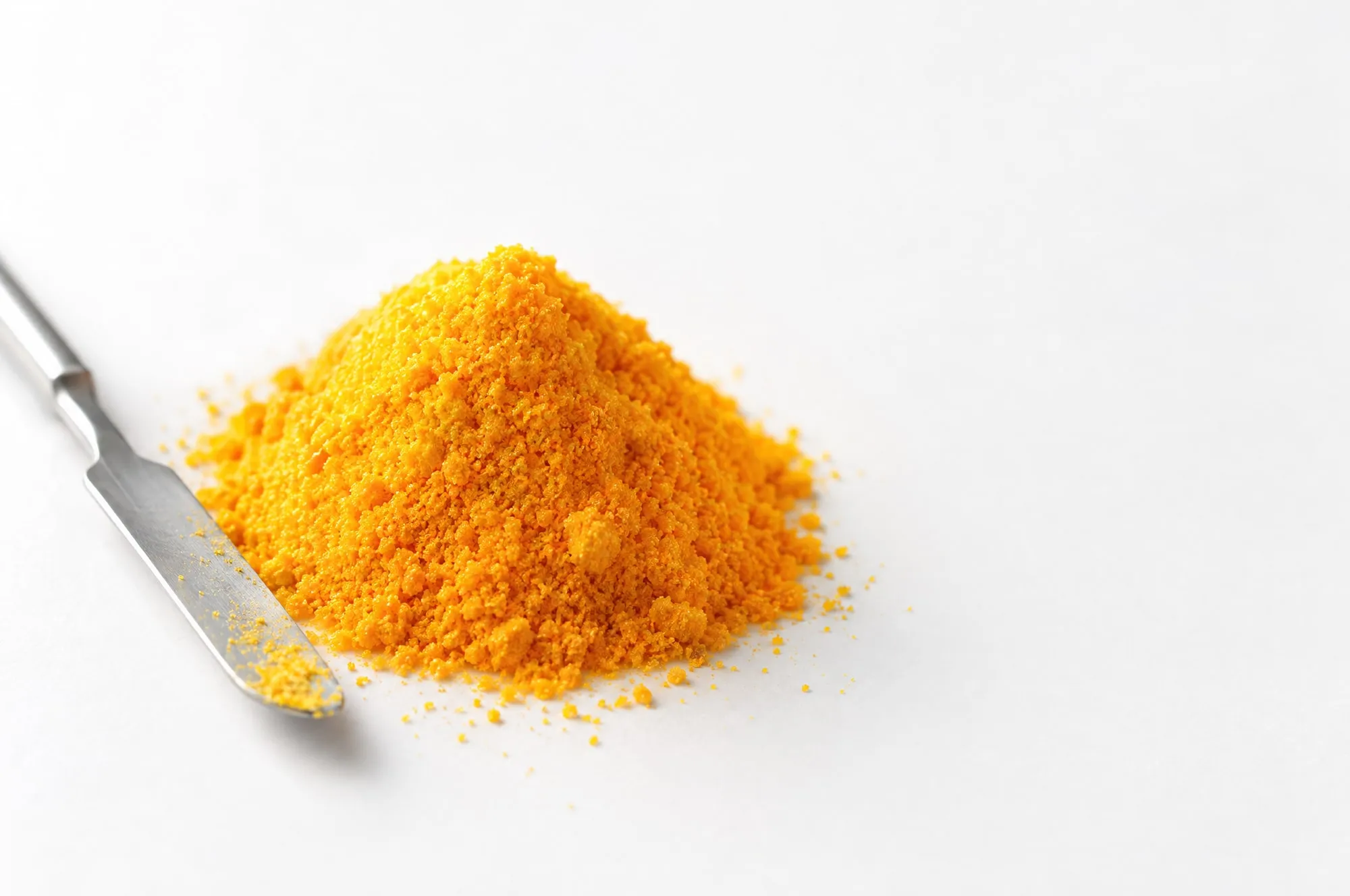
Riboflavin is vitamin B2, a yellow to orange-yellow crystalline powder (CAS 83-88-5) used to fortify food, formulate supplements and beverages, and supplement animal feed.
Identity
What it is.
Riboflavin is the vitamin every enriched flour, most multivitamins and nearly every poultry and swine ration contains. Commercial riboflavin is made by fermentation and sold in two broad forms: a high-assay crystalline powder for food, beverage and supplement use, and an 80% spray-dried granule for feed.
It is our flagship product. We make it by fermentation at our own plant and supply the USP and food grades to premixers, supplement manufacturers and beverage formulators, and the 80% feed grade to feed and pet-food premixers.
Also known as: Vitamin B2, Lactoflavin, Vitamin G, E101(i).
- CAS number
- 83-88-5
- Molecular formula
- C₁₇H₂₀N₄O₆
- Molecular weight
- 376.36 g/mol
- Appearance
- Yellow to orange-yellow crystalline powder
- Solubility
- Very slightly soluble in water; more soluble in dilute alkali
- HTS heading
- 2936.23
- Country of origin
- China
Specifications
Grades and specifications.
Every batch is tested against the specification below and shipped with a certificate of analysis reporting the result and method for each test.
Riboflavin USP
High-assay crystalline powder for supplements, food fortification and beverages.
| Test | Specification | Batch result | Method |
|---|---|---|---|
| Description | Yellow to orange-yellow crystalline powder | Conforms | Visual |
| Identification | Conforms | Conforms | USP <197> |
| Assay | 98.0% – 102.0% | 101.0% | USP |
| Specific rotation | −115° to −135° | −132.0° | USP <781S> |
| Lumiflavin | NMT 0.025 | 0.009 | USP <857> |
| Loss on drying | NMT 1.5% | 0.26% | USP <731> |
| Residue on ignition | NMT 0.3% | 0.05% | USP <281> |
| Lead | NMT 1 ppm | < 1 ppm | USP <251> |
| Arsenic | NMT 1 ppm | < 1 ppm | USP <211> |
| Cadmium | NMT 1 ppm | < 1 ppm | AAS |
| Mercury | NMT 0.1 ppm | < 0.1 ppm | USP <261> |
| Bulk density | NLT 0.30 g/mL | 0.31 g/mL | USP <616> |
| Tapped density | NLT 0.50 g/mL | 0.58 g/mL | USP <616> |
| Particle size | 95% through 80 mesh | Conforms | USP <786> |
| Aerobic plate count | NMT 1,000 CFU/g | < 1,000 CFU/g | USP |
| Yeast and mould | NMT 100 CFU/g | < 100 CFU/g | USP |
| E. coli | Negative | Negative | USP |
Riboflavin Food Grade (GB 14752)
Food-additive grade to the Chinese national standard, for food fortification and export markets.
| Test | Specification | Batch result | Method |
|---|---|---|---|
| Appearance | Orange-yellow crystalline powder | Conforms | GB 14752 |
| Assay | 98.0% – 102.0% | 100.2% | GB 14752 |
| Specific rotation | −120° to −140° | −133.5° | GB 14752 |
| Lumiflavin | NMT 0.025 | 0.004 | GB 14752 |
| Loss on drying | NMT 1.5% | 0.34% | GB 14752 |
| Residue on ignition | NMT 0.3% | 0.10% | GB 14752 |
| Arsenic | NMT 2 ppm | < 2 ppm | GB 14752 |
| Lead | NMT 1 mg/kg | < 1 mg/kg | GB 5009.12 |
| Aerobic plate count | NMT 1,000 CFU/g | < 1,000 CFU/g | GB 4789.2 |
| Yeast and mould | NMT 25 CFU/g | < 25 CFU/g | GB 4789.15 |
| E. coli | Negative | Negative | GB/T 4789.38 |
Riboflavin 80% Feed Grade
Free-flowing granule for vitamin premixes and compound feed.
| Test | Specification | Method |
|---|---|---|
| Riboflavin content | NLT 80.0% | — |
| Appearance | Yellow to brownish-yellow granule | — |
Packaging and storage
- Packaging
- 25 kg drums
- Shelf life
- 3 years from manufacture
- Storage
- Tightly closed container in a dry place, protected from light
- Production
- Fermentation, at our plant in Xintai, Shandong
Applications
Where it is used.
Food fortification and premix
Enriched flour, cereal, pasta and rice premixes; nutrient blends for bars and meal replacements; colour (E101).
Industry pageDietary supplements
Multivitamins, B-complex tablets and capsules, gummies and powders.
Industry pageFunctional beverages
Energy drinks and drink mixes, usually as part of a B-vitamin premix. Where solubility is limiting, see riboflavin 5′-phosphate sodium.
Industry pageAnimal nutrition
Vitamin premixes for poultry, swine, aquaculture and pet food, normally as the 80% feed grade.
Industry pageRegulatory
Regulatory status.
A summary for formulators and quality teams.
Food use in the United States
Riboflavin is affirmed as generally recognized as safe (GRAS) as a nutrient supplement under 21 CFR 184.1695, when it meets Food Chemicals Codex specifications. It is a required nutrient in enriched flour under 21 CFR 137.165.
Feed use
Riboflavin is listed as generally recognized as safe in animal feed under 21 CFR 582.5695.
Compendial standards
Monographs for riboflavin exist in the USP, the Food Chemicals Codex and the European Pharmacopoeia. Our certificates of analysis cite the monograph and method each test was run to.
Documentation
Documentation, as standard.
Every shipment carries a certificate of analysis that names our manufacturing site, Xintai Jiahe Biotech Co., Ltd.. The full document pack is sent with your quotation, so your QA review can start straight away.
Also tested by Centre Testing International (CTI), an independent laboratory. The report is available on request.
- Certificate of analysis for the batch
- Specification sheet
- Safety data sheet (SDS)
- Test methods
- FSSC 22000, ISO 9001, HACCP and Halal certificates
- Allergen statement
- GMO statement
- Residual solvent statement
- Heavy-metal results
- Country-of-origin statement
- Supply-chain traceability statement
Questions
Riboflavin: common questions.
Is riboflavin the same as vitamin B2?
Yes. Riboflavin is the chemical name for vitamin B2. It has the CAS number 83-88-5 and the formula C₁₇H₂₀N₄O₆. On food labels in Europe it also appears as E101.
What is the difference between USP grade and feed grade riboflavin?
USP grade is a crystalline powder assaying 98.0% to 102.0% riboflavin on the dried basis, tested to the USP monograph, and used in food, beverages and supplements. Feed grade is a spray-dried granule containing at least 80% riboflavin, made to flow and mix well in vitamin premixes for animal feed.
Is riboflavin GRAS?
Yes. In the United States riboflavin is affirmed as GRAS for use as a nutrient supplement in food under 21 CFR 184.1695, and is generally recognized as safe in animal feed under 21 CFR 582.5695.
Does riboflavin dissolve in water?
Only slightly. Riboflavin is very slightly soluble in water, which limits its use in clear liquids. Formulators who need a water-soluble form of vitamin B2 normally use riboflavin 5′-phosphate sodium instead.
How is commercial riboflavin made?
Almost all commercial riboflavin is now produced by microbial fermentation, followed by purification and crystallization or spray drying. Fermentation replaced multi-step chemical synthesis across the industry.
What documents come with an order?
Every batch ships with its own certificate of analysis. We also provide the specification sheet, safety data sheet, test methods and the supplier statements your QA team will ask for, including allergen, GMO and heavy-metal statements.
Quote Riboflavin.
Get pricing and full documentation in one inquiry. Our team responds within one business day.